

On a Scale From 0 to 10: How Is Your Pain Today?
If you've been hurt in a car wreck, a slip and fall, or a workplace accident, you already know the pain doesn't stop at the emergency room. It's the ache that wakes you up at 3 a.m. It's the sharp pull when you reach for something on a shelf. It's the fatigue that comes from your body fighting an injury all day, every day.
And at nearly every doctor's visit, someone hands you the same question: "On a scale from 0 to 10, how is your pain today?"
That number matters more than it seems like it should.
Why the Number Matters
Pain is subjective. There's no blood test or X-ray that shows a "7." But the number you give your doctor becomes part of your permanent medical record, and in a personal injury claim, that record is often the single most important piece of evidence for what you went through and what it's worth.
Chronic pain is widely recognized in medical literature as capable of significantly limiting a person's daily function and quality of life when it persists. Insurance adjusters, defense attorneys, and eventually a jury will read your numbers looking for exactly that: whether your reported pain lines up with a real, ongoing limitation. If your answers are inconsistent, inflated, or vague, they can undercut your credibility even when your pain is completely real.
How Insurance Companies Actually Use These Numbers
It helps to understand what happens to your pain ratings after you leave the doctor's office. Adjusters and defense attorneys don't just glance at them, they build a case against you around them.
They check for consistency. Every rating from every provider gets compiled into a timeline. An 8/10 at the ER followed by a 3/10 two days later at the orthopedist, then a 7/10 the following week, with nothing in between to explain the swing, becomes cross-examination material. The problem isn't a low number, it's an unexplained one. Unexplained swings read as unreliable, whether or not the pain itself is real.
They compare it against what you're doing. A reported 8/10 sits awkwardly next to a photo of you at a birthday party looking fine, or surveillance footage of you carrying groceries without any visible difficulty. Insurers routinely review social media, and in higher-value claims may order surveillance, specifically to develop that kind of contrast. Your pain scale entries are the anchor they need something to contradict.
They track your recovery trajectory. Adjusters compare your reported pain trend against the expected healing curve for your diagnosis. If a soft tissue injury is still rated 7/10 at month six with no imaging finding to explain it, that gets flagged, either as a pre-existing condition, an unrelated cause, or treatment that went on longer than necessary. This feeds two of the defense's favorite arguments: that some of your treatment wasn't reasonable and necessary, and that your damages should be capped at the point your injury "should have" resolved.
They use it in independent medical exams. If your case reaches an IME, the examining doctor is handed your full pain scale history and asked to reconcile it against their own findings on range of motion, muscle guarding, and gait. Any mismatch becomes part of their report and often shows up again at deposition or trial.
They use it to value the claim. Some adjusters still calculate pain and suffering with a multiplier based on injury severity. Your self-reported pain levels help determine how severe they code your injury for that calculation, especially when there's no imaging to establish severity on its own.
None of this means you should inflate your pain to build a bigger number. It means the opposite: consistency and specificity in how you describe your pain are what keep it from being used against you later.
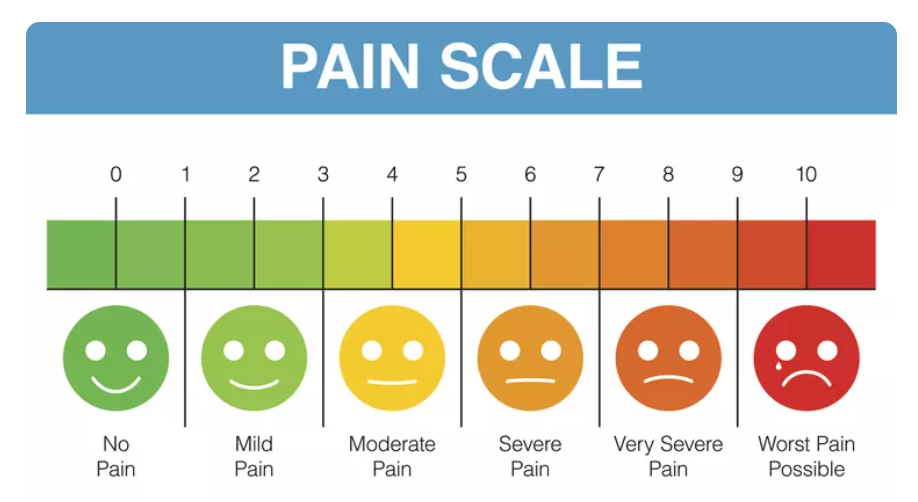
What the Numbers Actually Mean
Most providers use some version of this rough breakdown:
- 0 — No pain
- 1–3 — Mild pain (noticeable, but doesn't stop you from your normal activities)
- 4–6 — Moderate pain (interferes with concentration, sleep, or daily tasks)
- 7–9 — Severe pain (makes it hard to function, concentrate, or hold a conversation)
- 10 — The worst pain imaginable
Knowing this scale helps you land on a number that actually reflects your experience, rather than guessing.
How to Answer Accurately
Don't inflate it. A higher number doesn't lead to a better personal injury settlement; it leads to a credibility problem if the rest of your records don't support it.
Don't minimize it either. Toughing it out doesn't help your recovery, and it creates a paper trail that understates your actual condition. Tell your doctor everything you're experiencing so they can treat you properly.
Use words along with the number. "6, and it's a burning pain that runs down my left leg when I stand for more than a few minutes" tells your doctor, and later, an adjuster or a jury, far more than "6" alone.
Be consistent, but don't be afraid of a real change. If you don't remember what you reported last visit, ask the front desk to pull it up rather than guessing. Pain genuinely does fluctuate, and a flare-up after starting physical therapy or a bad night's sleep is normal. The issue isn't a number that moves, it's a number that moves with no explanation. If today is worse than last time, say why: "worse today, I started PT on Tuesday and it's been sore since."
Ask to see the scale your provider uses. Not all pain scales are identical, and understanding the one in front of you helps you answer it accurately.
Save a 10 for true emergencies. A 10 means pain so severe you can't hold a conversation. If you report a 10 at every visit for six months, it reads as exaggeration, whether or not that's fair.
Why Some Offices Combine Numbers and Faces
You may notice some providers use a version of the numeric scale that also shows a small facial expression above each number, rather than the plain 0-10 line. This isn't the same as the Wong-Baker scale used for children, it's a hybrid built for adults who are still asked to give a number, but benefit from a visual anchor next to it.
The reason is calibration. "7" means something different to different people depending on their personal pain history, tolerance, and even mood that day. A facial expression next to each number gives every patient the same visual reference point, which reduces the odds that one person's "5" is another person's "8" for a comparably severe injury. For your claim, that consistency works in your favor: it makes your own ratings more reliable across visits, and it makes your provider's documentation harder for an adjuster to dismiss as arbitrary or inflated.
Get Help Making Sure Your Pain Is Documented Correctly
Your medical records are the backbone of your bodily injury claim. Every pain rating in your chart becomes evidence, whether it helps your claim or hurts it. If you're not sure your records currently tell an accurate, consistent story of your injury, that's worth catching now, not after the insurance company has already built its file.
Hagen Rosskopf has represented injured people in Atlanta for more than 30 years, and we know how adjusters read a medical chart before they ever make an offer. If you've been hurt because of someone else's negligence, you may be entitled to compensation for your medical bills, lost income, and pain and suffering.
Call 404-522-7553 for a free consultation. There's no fee unless we win your case.