
How a Flawed Police Report Nearly Cost Two Injured Cyclists Their Compensation
Quick answer: Two adult siblings riding an e-bike in Atlanta were struck by a driver who failed to yield while turning left, a clear violation of Georgia law, yet the responding officer issued no citation and twice noted the cyclists weren't wearing helmets, even though Georgia law doesn't require helmets for riders over 16. With only $25,000 in the driver's liability coverage and no UM/UIM coverage of their own, Hagen Rosskopf negotiated each sibling's roughly $65,000 ER bill down to $200, making full compensation possible despite minimal insurance.
Case Study 3 of 30: Two Cyclists v. Car Driver
This case study is a real story from a bike case Hagen Rosskopf handled for real clients. Details are shared to show what's possible when a cycling accident claim is fully investigated, not as a hypothetical or a marketing example.
What Happened
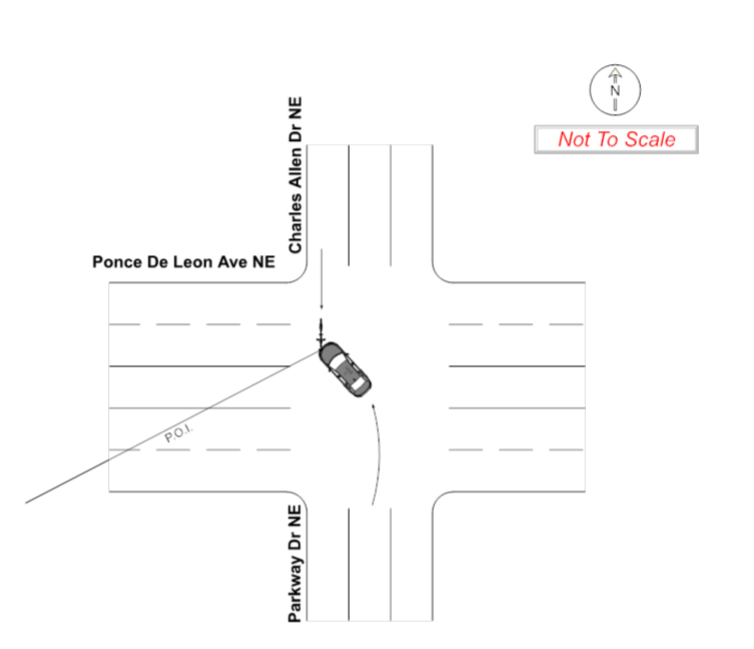
In May 2024, 20-year-old siblings, referred to here as A. and S., were riding their e-bike together in Atlanta, Georgia. A car driver failed to yield while making a left turn and struck them both.
Both siblings were transported by ambulance to Grady Memorial Hospital. They suffered significant abrasions and contusions, and their ER bills alone came to close to $65,000 each.
A Police Report That Worked Against Them
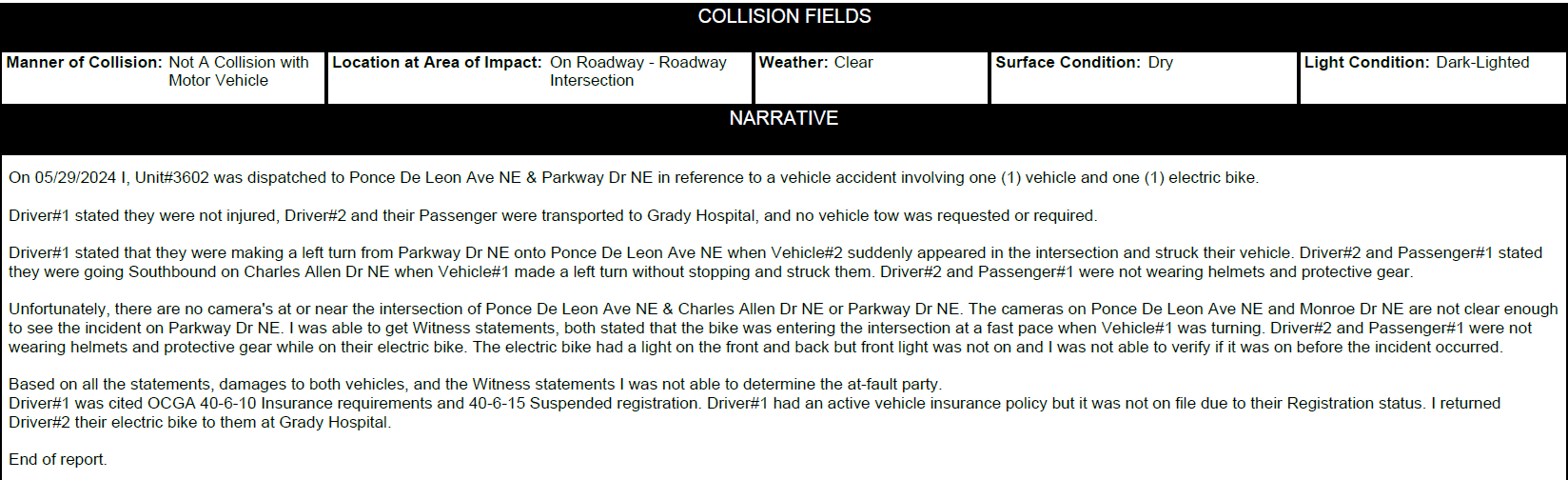
The investigating officer's report contained two problems that, left unchallenged, would have made this case far harder to win.
First, the report noted twice that the cyclists "were not wearing helmets and protective gear." Under Georgia law, O.C.G.A. § 40-6-296, only cyclists under 16 are required to wear a helmet. Both A. and S. were 20. Not only were they not violating any law, the same statute explicitly states that a helmet violation "shall not constitute negligence per se nor contributory negligence per se or be considered evidence of negligence or liability." In other words, even for a rider who is legally required to wear one, going without a helmet cannot be used against them to establish fault. Here, the note wasn't even legally relevant to begin with.
Second, and more significant, the driver was not issued a traffic citation, despite failing to yield while turning left directly into the path of two cyclists. Georgia law is unambiguous on this point. O.C.G.A. § 40-6-71 states that a driver intending to turn left must yield the right of way to any vehicle approaching from the opposite direction that is close enough to constitute an immediate hazard, and Georgia courts have long treated a violation of this kind of traffic statute as negligence per se, meaning the violation itself can establish that the driver was negligent as a matter of law.
A police report that highlights an irrelevant detail about helmets while omitting an available citation for a clear right-of-way violation makes it easier for an insurance company to dispute or minimize a claim. That's exactly the kind of report that requires an independent investigation rather than being taken at face value.
The Real Problem: Not Enough Insurance to Cover the Bills
To the insurance company's credit, in this case it accepted responsibility for its driver early on. But accepting fault didn't solve the core problem: the driver carried only $25,000 in liability coverage on his auto policy, and A. and S. did not have uninsured/underinsured motorist (UM/UIM) coverage of their own. Split between two injured people, that $25,000 wasn't enough to cover even one sibling's ER bill, let alone both.
How We Made Full Compensation Possible
The key move in this case wasn't a courtroom argument. It was determined negotiation with the hospital itself. Our team was able to negotiate each sibling's roughly $65,000 ER bill down to $200.
That single move changed the entire outcome. Instead of insurance proceeds being entirely consumed by hospital bills, reducing those bills freed up the available coverage to actually compensate A. and S. for their injuries, not just pay off Grady.
The Legal Team Behind the Case
- Matt Hagen — Personal injury attorney based in Decatur, Georgia
- Kimberly Hart — Pre-litigation case manager
- Amie Risley — Negotiations paralegal
Hagen Rosskopf operates as Bike Law Georgia, part of Bike Law USA, a national network of attorneys who focus exclusively on representing injured cyclists and advocating for safer roads.
What This Case Shows
A police report isn't the final word on a bicycle accident claim, and it can contain both irrelevant details and significant omissions. It's also a reminder of why every cyclist should strongly consider carrying UM/UIM coverage on their own auto policy, even if they don't drive often: Georgia law doesn't require drivers to carry enough liability insurance to cover a serious injury, and a driver's minimum policy limits can leave an injured cyclist with almost nothing to work with unless their own coverage, or aggressive medical bill negotiation, closes the gap.
Frequently Asked Questions
Do adult cyclists have to wear a helmet in Georgia? No. Georgia law, O.C.G.A. § 40-6-296, requires a helmet only for cyclists under 16 years old. Riders 16 and older are not legally required to wear one, and the statute specifically states that failing to wear a helmet cannot be used as evidence of negligence in a legal claim, even for a rider who is legally required to wear one.
Who is at fault when a driver turning left hits a cyclist in Georgia? Generally, the driver. O.C.G.A. § 40-6-71 requires a driver turning left to yield to oncoming traffic close enough to be an immediate hazard, including cyclists. A violation of this statute can support a finding of negligence per se. That said, insurance companies don't always accept fault automatically, and a police report that fails to cite the driver can make a claim harder to prove without an independent investigation.
What is UM/UIM coverage, and how does it work in Georgia? Uninsured/underinsured motorist (UM/UIM) coverage is coverage on your own auto policy that steps in when the at-fault driver has no insurance, or not enough insurance, to cover your damages. Georgia doesn't require drivers to carry it, but O.C.G.A. § 33-7-11 requires every insurer to offer it when you buy or renew a policy, and you must reject it in writing if you don't want it. Georgia also gives policyholders a choice between two structures: "add-on" (stacking) coverage, where your UM limits are added on top of the at-fault driver's liability coverage, and "reduced-by" coverage, where your UM benefit is reduced by whatever the at-fault driver's insurance pays. Add-on coverage generally provides significantly more protection. In this case, A. and S. had no UM/UIM coverage at all, which is exactly the gap that left them dependent on a $25,000 policy limit split two ways, and exactly the kind of gap that a modest UM policy, at a relatively small added premium, would have closed.
Injured in a bicycle accident in Atlanta with limited insurance available? Contact Hagen Rosskopf, our Atlanta bicycle accident attorneys, for a free consultation. There's no fee unless we win your case.