
A 45-Year-Old Georgia Law and a 1983 Court Ruling Built This Cyclist’s Case Against City of Atlanta
Quick answer: A cyclist was seriously injured on Plasters Ave NE in Atlanta when her bicycle wheel caught in a negligently installed storm drain grate. Hagen Rosskopf used a 1978 Georgia statute requiring bicycle-safe grate installation and a 1983 Georgia Court of Appeals ruling that put the City on notice of exactly this hazard decades earlier to obtain a settlement without ever filing a lawsuit.
Case Study 5 of 30: Cyclist v. City of Atlanta
The details below come from an actual case Hagen Rosskopf handled for a real client, not a composite or a hypothetical built to illustrate a legal point.
The Crash
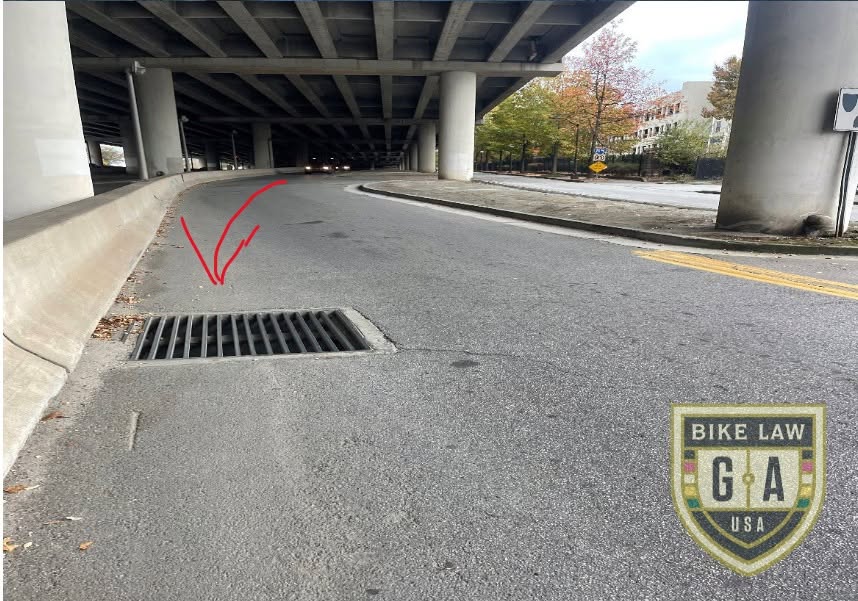
A cyclist was seriously injured by a negligently installed and maintained storm drain grate while riding on Plasters Ave NE in Atlanta, Georgia. She had recently relocated from another state and was unfamiliar with the area.
Why the City Should Have Known Better
Plasters Ave sits near the unfinished terminus of the Beltline at Mayson Street, and that mattered a great deal to this case. It was reasonably foreseeable to the City of Atlanta that this stretch of road had become heavily trafficked bicycle infrastructure precisely because of its proximity to the Beltline. Unlike the cyclist, who was new to the area and had no way of knowing about a hazard she'd never encountered before, the City had superior knowledge of a dangerous condition it had both created and continued to maintain.
A Law from 1978, and a Court Ruling from 1983
This is where digging into Georgia's legal history, combined with our firm's experience with cases involving defective public infrastructure, made the difference.
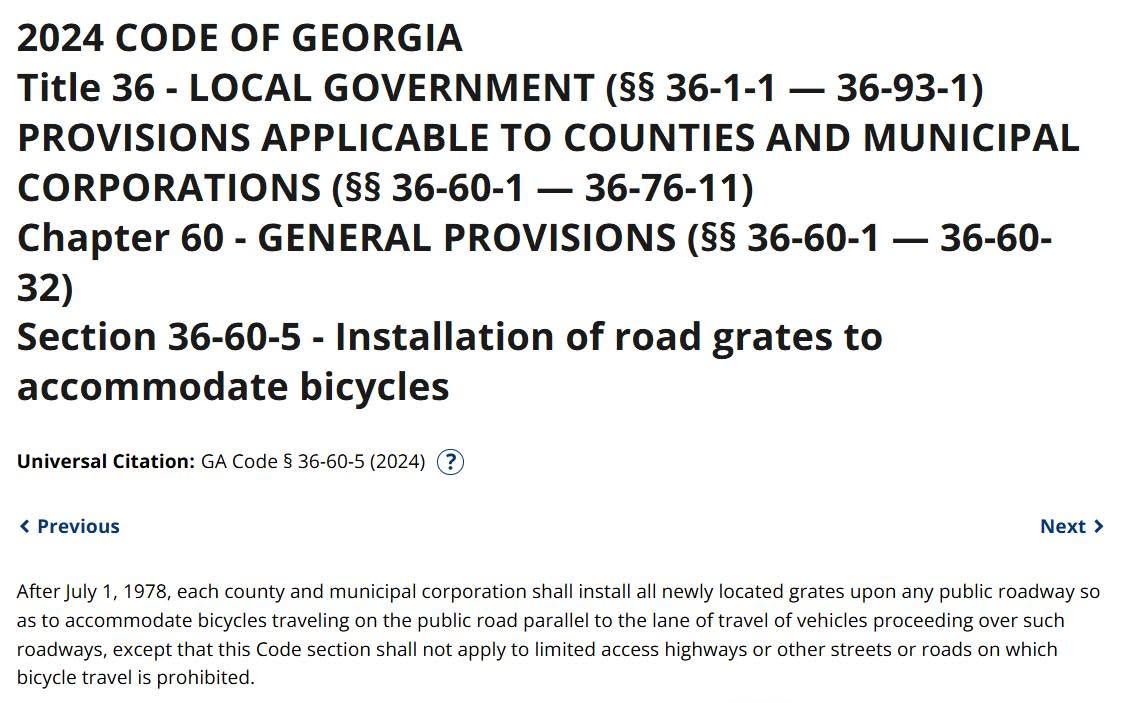
In 1978, Georgia passed O.C.G.A. § 36-60-5, which requires every county and municipality to install newly located roadway grates so that the bars run parallel to the direction of travel, specifically to keep a bicycle tire from sliding into the gap. The City of Atlanta has been operating under this legal requirement for well over four decades.
Five years after that law took effect, the Georgia Court of Appeals decided DeWaters v. City of Atlanta, 169 Ga. App. 41 (1983), a case with a strikingly similar fact pattern: a cyclist's wheel caught in a sewer grate whose bars ran parallel to the curb. The court found that the City was generally aware sewer grates with bars parallel to the curb pose a potentially dangerous obstruction to some cyclists using city streets.
Put together, these two facts meant the City of Atlanta could not credibly claim it didn't know a parallel-bar grate posed a real risk to cyclists. It had been the law for over 40 years, and a court had already told the City as much in writing, more than four decades before this crash.
The Same Street, Installed Two Different Ways
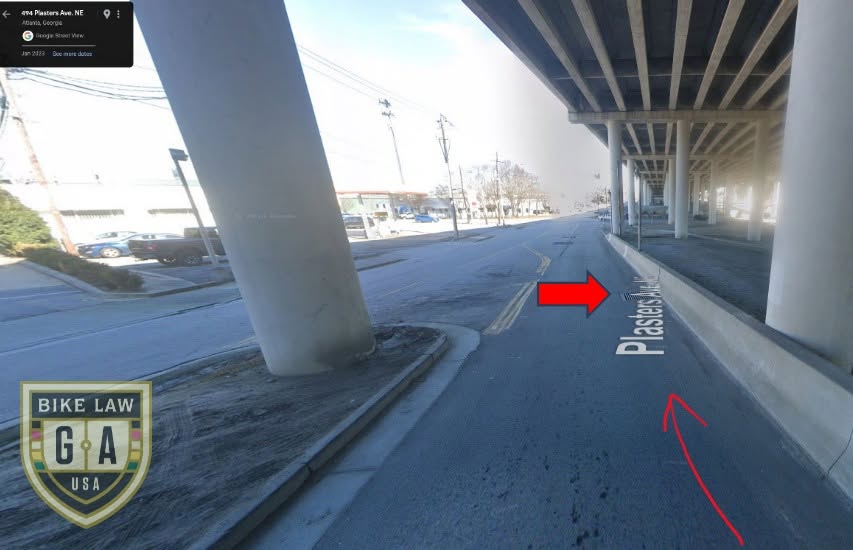
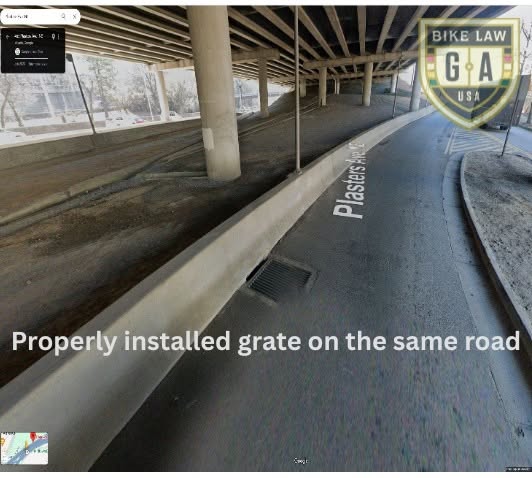
One detail made this case especially hard for the City to explain away: grate inlets in the same westbound lane of Plasters Ave, just to the east of the crash site, were properly installed and maintained. The City wasn't dealing with a citywide standard it had simply never learned about. On the very same stretch of road, it had gotten the installation right in one place and wrong in another.
How the Case Resolved
Matt Hagen sent an ante-litem notice to City of Atlanta along with a demand to begin the negotiations process. The City was initially slow in responding to the notice but once it was established that the storm drain was maintained by City of Atlanta, the tone of the negotiations improved. A settlement was reached for the cyclist without ever needing to file a lawsuit.
Report It: How ATL311 Helps Build the Record This Case Relied On
This case turned on what the City of Atlanta could be shown to have known, and for how long. That's exactly why reporting hazards matters, not just for your own safety, but for the safety of everyone who rides, walks, or drives that same stretch of road after you.
Cyclists, pedestrians, and drivers alike can report potholes, improperly installed grates, missing signage, and other road hazards to the City of Atlanta through ATL311, either online at ATL311.com, by calling 311 (404-546-0311 from outside city limits), or through social media. ATL311 maintains active accounts on Facebook, Instagram, and X under the handle @ATL311, and monitors these channels for service requests and reported issues in addition to phone and web submissions. Whichever channel you use, include a photo of the hazard and the specific location, such as a street address, nearest cross street, or GPS coordinates, since a vague description ("pothole near my apartment") is far harder for the city to act on, and far less useful as evidence later, than a report anchored to a clear location with visual proof of the condition. Reports can typically be tracked and their status checked afterward, which creates a time-stamped record of exactly when the city was told about a problem.
That record matters. A single 311 report might not, by itself, prove a city had the kind of long-standing knowledge that helped resolve this case, but a pattern of reports about the same hazard, especially ones that go unaddressed, can become powerful evidence that the city knew and failed to act. It's the same principle that made the decades-old statute and court ruling so effective here: a government entity has a much harder time claiming ignorance when there's a documented paper trail showing otherwise.
One important distinction: filing a 311 report is not the same as the formal ante litem notice Georgia law requires before you can sue a city for your own injury. Under O.C.G.A. § 36-33-5, anyone injured by a city's negligence has only six months from the date of the incident to submit a written claim to the city's governing authority, by certified mail or statutory overnight delivery, describing the time, place, and extent of the injury, the negligence involved, and a specific dollar amount of damages sought. Missing that deadline, or getting the notice wrong, can bar an otherwise valid claim entirely, regardless of how many 311 reports exist. If you've been injured because of a road hazard, reporting it to 311 is a good civic habit, but it doesn't substitute for contacting an attorney quickly to protect your own legal claim.
The Team Behind the Bike Case
- Matt Hagen and Bruce Hagen — Father and Son Team of Personal Injury Lawyers
- Kimberly Hart — Case manager
- Dan Pruitt — Paralegal
- Amie Risley — Negotiations paralegal
Bruce Hagen and Matt Hagen are part of Bike Law USA, a national network of attorneys who focus exclusively on representing injured cyclists and advocating for safer roads.
What This Case Shows
A government entity's liability for dangerous infrastructure often hinges on what it can be shown to have known, and for how long. A statute on the books for decades and a court decision addressing the exact same hazard aren't just background research, they're often the evidence that turns "the City didn't realize this was dangerous" into a legal impossibility. This kind of outcome depends on knowing where to look for that history in the first place.
Frequently Asked Questions
Can you sue the City of Atlanta for an injury caused by a road hazard? In certain circumstances, yes. Georgia municipalities generally have sovereign immunity, but that immunity isn't absolute, particularly where a case involves the city's maintenance of a public roadway and evidence that the city had knowledge of the specific hazard. Every case depends on its facts, and an attorney should evaluate whether an exception to immunity applies.
Does Georgia law require a specific way to install storm drain grates? Yes. O.C.G.A. § 36-60-5 has required, since 1978, that any newly located grate on a public roadway be installed so its bars run parallel to the direction of travel, specifically to prevent a bicycle tire from sliding into the gap between bars. A grate installed with bars running the wrong direction, perpendicular to travel or parallel to the curb, can create exactly the kind of hazard this law was written to prevent.
How do you prove a city knew about a dangerous road condition for years? Through a combination of documentary and physical evidence. Evidence can include the length of time a hazard has existed, prior legal history addressing the same type of hazard (such as an appellate court decision), inconsistent installation or maintenance standards on the same stretch of road, and any records showing complaints or internal awareness. In this case, a decades-old statute and a Georgia Court of Appeals decision addressing the identical hazard both supported the argument that the City had long known about this exact risk.
What is an ante litem notice, and why does it matter for a claim against the City of Atlanta? An ante litem notice is a formal written notice Georgia law requires before you can sue a municipality. Under O.C.G.A. § 36-33-5, anyone injured by a city's negligence has only six months from the date of the incident to present a written claim to the city's governing authority, delivered by certified mail or statutory overnight delivery, stating the time, place, and extent of the injury, the negligence involved, and a specific dollar amount of damages. This deadline is far shorter than Georgia's general two-year statute of limitations for injury claims, and missing it, or failing to include required information, can permanently bar an otherwise valid claim, regardless of how strong the underlying case is. Reporting a hazard to ATL311 does not satisfy this requirement; anyone injured by a city-maintained hazard should contact an attorney promptly to make sure a proper ante litem notice is filed on time.
Injured by properly installed storm drain while cycling in Atlanta? Contact Hagen Rosskopf, our Atlanta bicycle accident attorneys, for a free consultation. There's no fee unless we win your case.